
Pick A Project, Not A Skill
the lottery of fascinations revisited

I have mixed feelings about the Lottery Of Fascinations concept.
On the one hand, it correctly identifies that skill is downstream of obsession; and it is also obviously true that you can’t just force yourself to be obsessed with a thing. I spent a great deal of time trying to force myself to master things I didn’t enjoy and it sucked each and every time.
But I think calling it a “lottery” is a bit of a misnomer. For myself, winning the Lottery Of Fascinations has been about a very simple question: is there some specific, concrete project I am obsessed with and requires mastering a specific skill or field of study? If there is, I’ll necessarily spec myself into that skill, and then suddenly my life trajectory is a little bit altered because now a whole bunch of lesser goals are now within reach.
But if no such project exists, I won’t.
This isn’t just me, by the way. Projects work as motivational engines in a way that other common sources of motivation just… don’t, and the usual “intrinsic vs extrinsic” framing educators reach for isn’t really the right categorization scheme for understanding what’s happening.
Here’s one I think carves nature closer to the joints.
The Types Of Motivation For Skill Acquisition
Project-Driven
There is a state of the world I’m very motivated to attain, and this possible world-state is the goal driving all of my behavior. In other words, I’m working on a project.
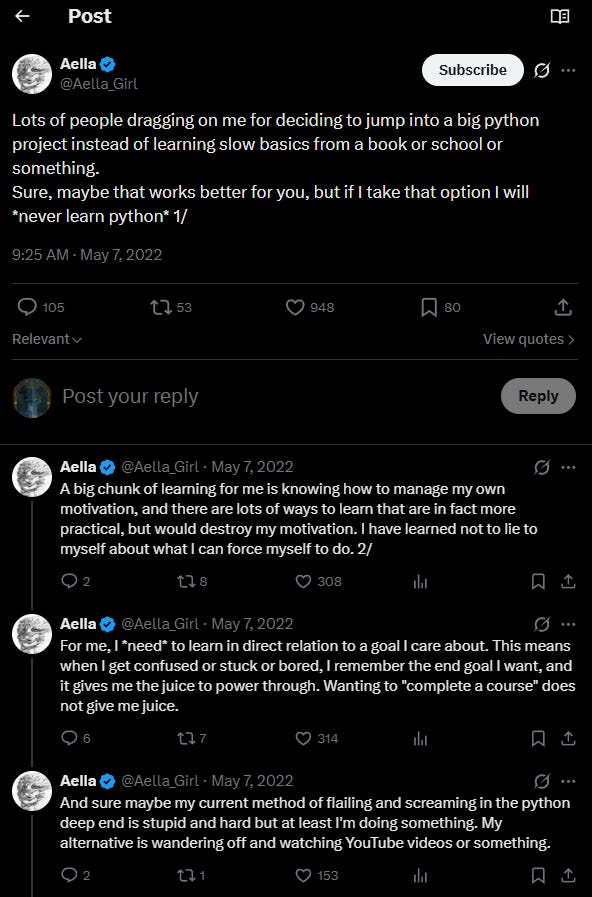
Example: My Experiences Learning Python
When I learned to program, this was actually entirely instrumental— I was trying to mod Fall From Heaven 2 to work on a very specific project and the relevant code was written in Python, so I necessarily had to learn enough Python to muck around productively in that codebase. And then I came out knowing Python. The pull of this project on my imagination was what got me through the tedious bullshit involved in learning to program (which there was a lot of!).
Example: My Experiences In Dance
I had a concrete goal in mind for the first few hundred hours: I wanted to be able to dance really well, at a level where I could flirt while dancing which is delightful but requires you have all that stuff drilled in your bones. This overriding goal was actually the thing pushing me through all the tedious and aversive shit required to get to that goal.
But after I got there, I kept training because once you get to where you can vibe while dancing you start to notice all the moves you could theoretically be choreographing from a given position. Could I get the follow into a hammerlock here followed by an inside turn? What if I used her hips to guide her into a left turn; would that work? You start to see the vast, vast expanse of the Dance State Machine in your imagination and then you need to see more.
This was basically a thing that started off as project-driven motivation and ended up being joy-driven.
Example: This Twitter Thread
Curiosity/Joy
I think a lot of informal AI researchers— Janus and Pliny, for instance— basically are in it for the love of the game. They see weird things one can do with LLMs and basically are asking themselves at each step: “cool, but can I get them to do this other thing? What happens if I set up this or that situation?” If you have a specific bizarre obsession other people don’t, at the tail end of it you’ll end up with either a shitload of weird, exotic knowledge or LLM psychosis. Or both!
I have another friend who, last I heard, was trying to get into AI safety research by way of chess LLMs. Not really because that’s an important cause area, but because the man loves chess and has an endless fascination with it, and this fascination pulls his attention into the work in a way that more-conventional AI safety directions won’t; and after learning enough to get this project to work suddenly other paths will be open to him because he has learned the skills that were instrumental in that project getting off the ground.
The very best mathematicians seem to select the problems they work on for something like aesthetic appeal; I’ve heard this is the deal for Terence Tao. Likewise: people who are really good at a specific game do it because they love the game and thus have spent countless hours exploring its nuances. I am, alas, extremely good at roguelike deckbuilders.
Educational
I think this is by far the worst and weakest motivation commonly in use: I have this goal because I chose the goal arbitrarily, so as to force myself to learn the skills necessary to achieve the goal. (The simplest example: doing math problems out of a textbook.)
I think it’s weak because at root I know I chose this goal arbitrarily. If tomorrow I decide this goal is silly and decide on a different one, literally nothing changes; which means it’s hard for the goal to remain stable since the question always exists: “might some other, different goal be just as effective in teaching me this? Does this goal have annoying properties which make it unsuitable for learning? Should I just skip this problem?”
This is the motivational structure around school assignments: school assignments structurally will almost never use either joy or projects-you-actually-care-about as motivational drives, which is why students have trouble focusing. (I never get tired of pointing out the fact that schools themselves need to bribe students with an extrinsic motivator— grades— to get them to do any work, which works exactly in proportion to how much the student in question cares about grades.)
In my previous essay about willpower I discuss the fact that “make pong” is a common piece of beginner gamedev advice, and that this advice sucks. I think it mostly sucks because you’re attempting to make use of the Educational motivation which is, by far, the worst possible type of motivation to use. (See also: Coursera course completion rates.)
Example: AI Safety Education
The beautiful nerds at London’s AI safety program— ARENA— flew me down there for a month to learn about the ins and outs of training neural nets and the frontier topic areas in AI safety, like how to DIY mechanistic interpretability (mechinterp for those in the know) or how to build steering vectors for arbitrary concepts. That was a pretty good time with (in my opinion) excellent pedagogy, and also, I bounced off it.
A contributing factor here is that AI tooling is a pain in the ass to use; every single AI person has to wade through their own bespoke series of CUDA errors and random stack traces complaining about arcane math failures deep within the bowels of pytorch. Nobody enjoys this bit; the difference between myself and someone for whom AI safety ends up working out as a career (I suspect) is whether that person has a specific project in mind they can apply this to.
So I think the reason I bounced off of it, in retrospect, is because I learned these tools well enough to get through the program and do its assigned problems but I didn’t, in the end, have any concrete project to apply them to which I thought was in any way genuinely relevant or useful to the overall project of preventing artificial superintelligence from killing us all.
So the knowledge just kind of lies fallow in my brain, for now.
(Also if you’re looking to get into AI safety the ARENA program is pretty great, highly recommended you apply.)
Example: My Experiences Learning The Trumpet
When I was a kid, my parents offered me the opportunity to learn an instrument. They said it would make me smarter, which I now notice is dubious reasoning but I didn’t really question it at the time so I said “okay!”
I think I never really graduated beyond the “I want to learn this skill so that I have this skill” phase; as such I didn’t really go beyond high school with it. I think it was still beneficial in that the band ended up being a huge chunk of my high school social life, but this was a fairly unsuccessful foray into mastering a complex skill.
(You’ll notice all the Educational examples are negative; I think educational motivation always has to hand off to some better motivational source if it’s to get you anywhere beyond Almost-Functional Deep Mediocrity, and frankly if you don’t have a degree program or peers pressuring you into it you probably won’t get even that.)
Joy Mostly Takes Effect Later, So You Need A Project
You’ll notice that Joy/Curiosity mostly comes into focus after a skill has been learned to a significant degree. That’s because, outside of games, Joy/Curiosity have a high skill floor to access; whereas games can be played enjoyable even when you’re just getting started. Indeed, a prerequisite for a game being successful is to be good at shepherding players through the learning phase of understanding the mechanics-- they need the player to get to Joy very very quickly or else the player will leave and find something else to do with their time.
Most domains of life are not constructed to have this gentle learning curve.
That means, I think, that the best way to learn any skill is to decide on a project that you care a lot about, or which speaks to you on a deep aesthetic level, and then get to work. It is irrelevant if you have the skills at this moment necessary to build the project; the point is to have a well-defined project that can serve as a motivation source for the tedious early bits of skill acquisition.
Which means before you do that you need to start noticing what projects could, in principle, have a pull on your imagination. Ask: for a given skill I want to learn, what is a corresponding project that would, if I accomplished it, be really fucking cool?
(It’s probably not Pong.)
See Also
Using Willpower Is A Leading Indicator Of Failure

When I was lurking r/gamedev back in the day, there was a weird little piece of advice that appeared with surprising regularity: “Don’t start with your dream project. Make Pong first. Then make Tetris. Polish it to a shine so that you know what it’s truly like to run even a small project.
Hmm, that clarifies why I dropped salsa: I was only trying it out because there were women in it, not because I give a fuck about dancing at an advanced level (or even in general).
I do find some things do grab me and are enjoyable immediately. Programming is one such thing, I thought it was fascinating even from my very first program. And BJJ is fun for me even if I suck and always lose.