
The Prosecution (Never) Rests
Reassurance-seeking as OCD-spectrum phenomenon

[Epistemic status: if you think I’m subtweeting you, no, I’m probably subtweeting one of several other people I know.]
Every so often on social media, you see someone whose feed is peppered with casual declarations of their own fundamental unlovability. “I feel like I kind of annoy everyone.” “Something about me is just off.” “I’m so ugly! I should forevermore wear a bag on my head that I might spare onlookers the sight of my horrific visage.”
The naive interpretation: this person just needed some reassurance. The process goes: this person feels bad → seeks reassurance → receives reassurance → feels better forever. But this isn’t what happens. Obviously.
What happens is: this person feels bad → seeks reassurance → receives reassurance → feels briefly better → feels bad again in a very slightly different (maybe) way within 48 hours → repeat.
If this were simple uncertainty about a fact, external evidence would resolve it. But it clearly doesn’t, not for more than a trivial period.
(There’s other subtypes— a person whose fear/desire for reassurance isn’t about being unlovable, it’s about maybe-being-a-bad-or-evil-person, or about being ugly, or about being cringe, or whatever. Same overall pattern.)
What exactly is happening, here?
Maybe The Real Hague Was Inside You All Along
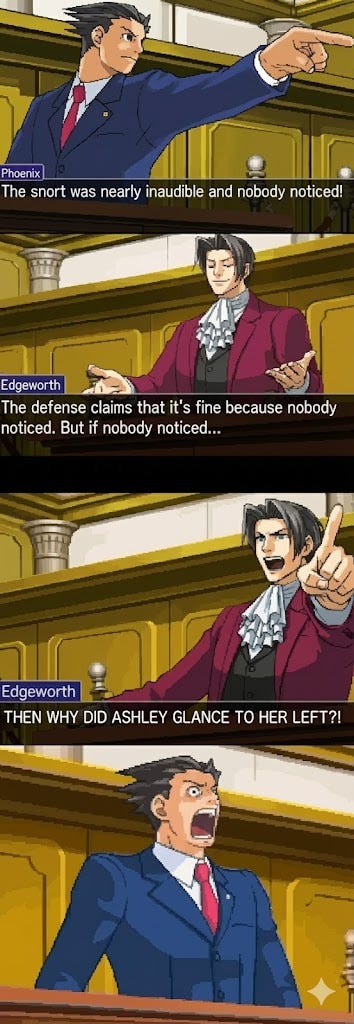
Here’s my theory: the reassurance-seeking is a side effect, rather than the primary process. The primary process is one of inventing new charges to file against yourself (or, equivalently, re-trying old charges that you previously filed but couldn’t disprove satisfactorily: “I think I am unattractive” is incredibly common among younger women in particular.)
The mind of someone caught in this loop is actively manufacturing frames through which to view themselves as deficient. “Hurtful and callous.” “Boring.” “Ugly.” Each manufactured angle arrives feeling like a plausible accusation demanding a fair trial rather than what it actually is: a politically-motivated case called forth by an internal District Attorney with infinite budget and a weak opposing counsel.
The specific angles are highly dependent on what the person’s deep-set fear about themselves is. These are the sorts of things I see different people compulsively generate:
Angles from which they might have accidentally hurt someone
Angles from which one might think they are weird or cringe or unloveable
Angles which imply they are worthless as a person
The reassurance-seeking is totally secondary. It’s merely one option for things you might do after an angle has been generated in order to handle said angle. You think you’re being epistemically responsible! You’re not just believing your own negative self-assessment, you’re checking it against external reality!
How admirably scientific of you.
Of course, the angle-generation has no natural stopping point. Sure, you’ve proven yourself innocent on nine charges, but why ought that help you against charge #10? It doesn’t, really, any more than being found innocent of the murder charge against Steve McDichael ought to help you in your attempts to demonstrate that you didn’t kill Bobson Dugnutt.
And now you must defend against a stream of invented criminal charges levied by yourself, against yourself.
Thanks, brain.
Maybe This is All Just Subclinical OCD
This whole cycle of [observe contaminant (social, physical, moral)]→ reassurance→ [observe new contaminant] contains all of the following elements:
A “contaminant” that can never be fully ruled out. You cannot definitively prove the absence of germs, cringiness, or being-a-secretly-bad-person with certainty. The territory is infinite and the evidence is always ambiguous. You especially can’t prove attractiveness, because attractiveness is fundamentally subjective; this is a total category error.
Checking that generates more material to check. The scrutiny itself produces false positives, ambiguous cases, and new angles of doubt. You can never be 100% proven uncontaminated, but the checking-for-contaminants will definitely make you feel like contamination is everywhere.
A category error about where the “contamination” lives. The person treats their internal discomfort (disgust, shame, guilt) as evidence of an external fact that can be verified or disproven through investigation. But the investigation can’t reach the thing they’re actually trying to resolve, which is the feeling of being [contaminated/cringe/ugly/guilty/ashamed] itself. And the reason for that is because this feeling was actually brought about by doing the investigation. The investigation can never resolve while it’s ongoing; and the feeling of it being unresolved fuels further investigation.
Temporary relief that reinforces the cycle. Cleaning/apologizing/asking for reassurance/doing further self-denial briefly reduces the anxiety around the concerned topic (“a terrible person wouldn’t have given that homeless person all their cash!”), which teaches the brain that the checking was necessary and useful and encourages more of it in the future.
Why External Reassurance Doesn’t Help And Never Will
First, the prosecution will always have some response as to why this particular instance of reassurance doesn’t count.
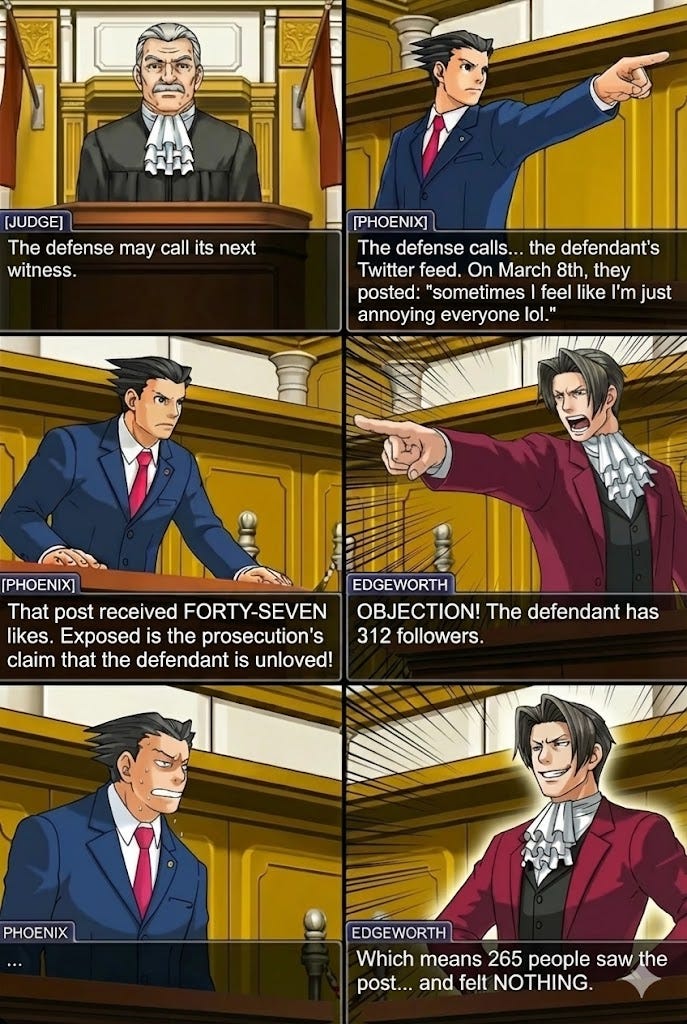
But even more fundamentally: even if every single court case lands in an “innocent” verdict, you’re still spending all your time in court. Being in court (in this sense) is the experience of anxiety; the innocent verdict doesn’t mean you didn’t experience the court case, it just means you get a temporary, brief reprieve before your internal District Attorney finds material with which to file a new case. Like the brief moment of sublime pleasure generated by scratching a mosquito bite before the itch comes back, worse than before.
The game is rigged. The only winning move is to notice you’re playing and then— crucially— to stop.
Reassurance-Seeking Is Just One Form Of Fact-Finding And It’s The Fact-Finding That’s The Problem
I used to do a version of this!
I didn’t actually ask reassurance (mostly it felt too cringe) but internally I was running a continuous audit of How Am I Being Perceived, and it felt important. Like I’d be negligent if I stopped. Like there was a real question, “did I act weird in that social encounter?”, that deserves a real answer, and abandoning the investigation would be irresponsible. Letting myself off the hook.
This rumination felt like essential fact-finding, which serves basically the same role as “seeking explicit reassurance” serves in other people. They are both evidence-collection exercises; it’s just that one of them has an external manifestation.
I felt this was important to pursue because “did I act weird in that social encounter” was really just a proxy question for the real thing I wanted to know: “am I fundamentally okay as a person?”
Thing is, “am I fundamentally okay as a person” isn’t actually a question. It’s not the kind of thing that has an answer in the way “is it raining out” has an answer. But it feels like a raining-type question. So it was very tempting to keep checking, to keep finding new proxy questions that I could slot in to help with finding an answer to the super-question: “am I fundamentally okay?”
That’s OCD, baby!
The Empty Courtroom
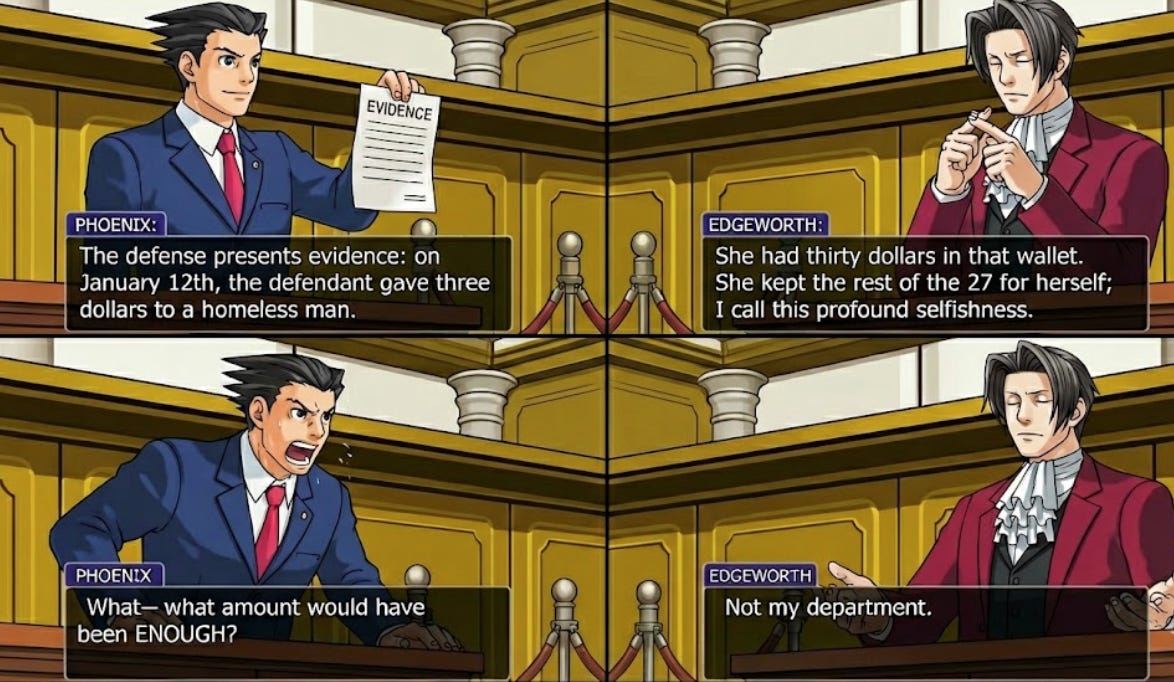
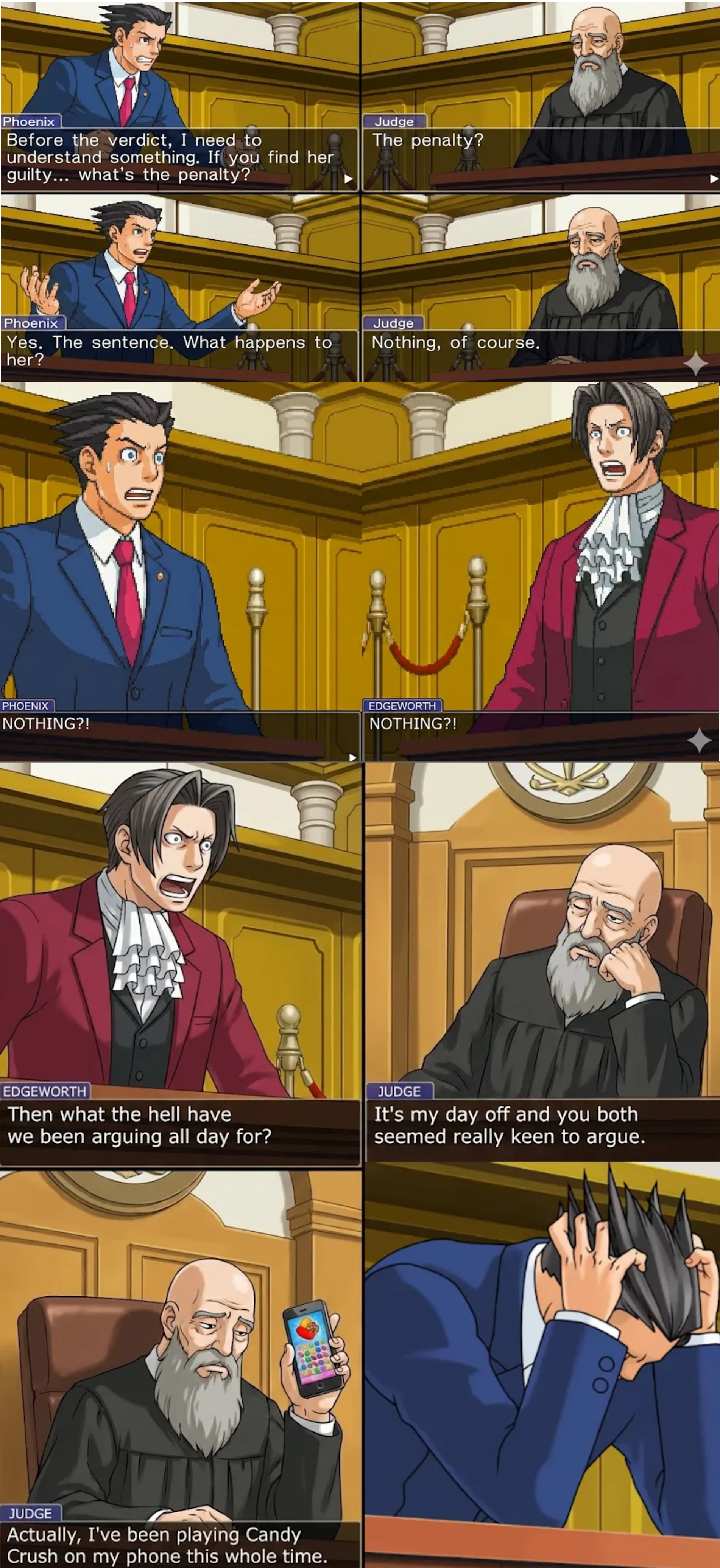
This courtroom has no judge. It has no jury. There’s no verdict coming. There will, in all likelihood, never be a court conducting the trial of “Am I Fundamentally Okay As A Human Being”.
There’s just two lawyers, arguing heatedly in front of an empty jury bench, forever. The court case will never be complete because completion isn’t what it’s for. It’s a process that exists to perpetuate itself, and the first step to knocking it off is recognizing this fact.
Regrettably this is not also the last step but frankly a lot of people don’t even get here so I’ll take what I can get.
The Difference Between Status Questions And Action Questions
An action question is something like: “Should I apologize? Should I act differently toward my partner? Should I conduct myself differently at parties?”
These have answers you can arrive at. And crucially, once you get the answer and do the thing, you’re done. “Should I apologize?” terminates in either apologizing or concluding you don’t need to. Either way, the question exhausts itself.
A status question is something like: “Am I a good person? Am I lovable? Am I fundamentally okay?”
These sometimes also have answers, in some vague, abstract sense. You can tell what they’re trying to get at. But the answer doesn’t terminate in anything. Suppose God Himself came down from the heavens to give you a definitive verdict—guilty or innocent, lovable or unlovable, okay or not okay. What would you do differently tomorrow?
Not a god-damn thing. You’d still try to be decent, still try to repair harms you’ve caused, still try to connect with people. The verdict is totally ephemeral.
Which is why the loop never ends. You’re trying to answer a question that doesn’t want an answer. “Am I a good person” wants a verdict, and the verdicts don’t do anything.
Status Questions Considered Harmful
When you notice yourself asking “am I okay as a person,” find the action question hiding underneath.
“Am I a bad friend?” might cash out to “I haven’t texted John back in three weeks and I feel guilty.” Great. Text John or decide you’re not going to. Done. The status question was a parasite on top of the action question, making it feel bigger and more existential than it needed to be while also neutering it of all actionability.
Sometimes there’s no action question underneath! “Am I somehow aversive” is floating free, unattached to any specific thing you did or should do. In that case: notice that you’re asking a question that doesn’t want an answer, and see if you can just... drop it.
There’s nothing to do. Which means there’s nothing to figure out. There was never anything to figure out.
Maybe Everything Is Secretly Just Subclinical OCD
A significant chunk of what we call “insecurity” or “anxiety” or “overthinking” is probably subclinical OCD that doesn’t get recognized because the content seems semi-plausible (the thoughts are “ego-syntonic”, in psych jargon). “I’m constantly convinced I hit someone with my car” is both bizarre and life-disruptive. “Maybe I acted weird at that party” is an impulse that is only mildly life-disruptive and also extremely normal, so we’re just like “people gonna social-anxiety, am I right?” It’s only recognized as “real clinical OCD” when we reach truly obvious and apocalyptic levels of dysfunction.
This matters because we have evidence-based treatments for OCD-spectrum disorders! And people aren’t accessing them because they don’t realize that’s what they have; and they don’t realize it because it’s masquerading as goodness or self-awareness.
Mull it over.
fin
As someone with diagnosed OCD, I feel like I see so much OCD around me compared to how common it supposedly is. Maybe OCD is just the natural result of high neuroticism?