
Vulnerability Is Making A Status Claim You're Willing To Let Fail
People hate doing that!

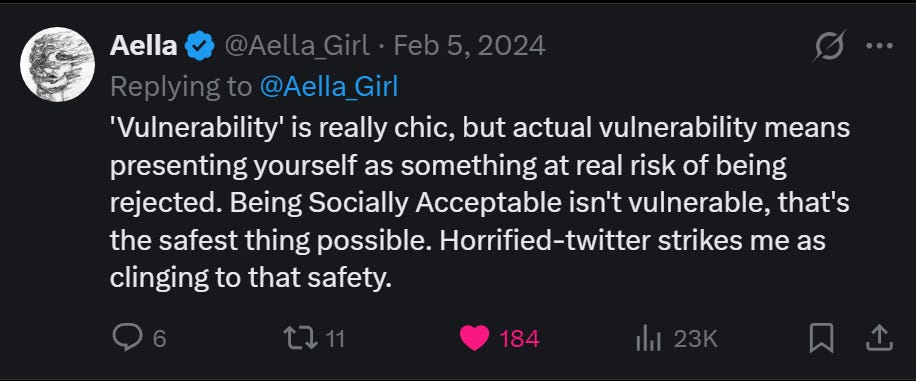
I mentioned in previous essays the concept of “vulnerable honesty” as one of three process goals that can replace anxious approval-seeking. I gave it the definition of “saying the thing you’re actually thinking instead of the thing you think is safe.” See also this:

That was true, I think, but incomplete. I didn’t explain why I think vulnerable honesty works in generating attraction and intimacy. I also think that some things that look like vulnerable honesty—trauma-dumping, self-deprecation, stating your desires prefaced with apologies—don’t actually function the same way at all, and I’ve felt vaguely guilty about not going deeper into this because I think it’s super important and underacknowledged.
So let’s talk about what the attractive, intimacy-generating form of vulnerability actually is.
Vulnerable Honesty Is Saying A Thing That Someone Might Shoot Down, Then Letting Them Do It
Here are two statements:
“I’d like to take you on a date.”
“I flew out to a workshop where we all hit on a bunch of girls.”
Both are honest and expose you to possible negative outcomes. The first invites rejection; the second invites judgment. The commonality is that there’s something they share that makes them vulnerably honest rather than just honest.
In both cases, you are making an implicit status claim and then handing the other person the power to disagree with it.
“I’d like to take you on a date” necessarily implies “I’m someone worth your romantic attention, and I deserve— at minimum— the amount of your time that it’ll take you to reject me.” The other person can now render a verdict on those two implicit claims. They might agree! They might not! You have put forward a thing-to-be-evaluated and you are going to sit there and shut up while they evaluate it.
“I went to this thing where I hit on a bunch of girls” implies “I’m the kind of person who does this, and I have decided that’s fine, and I have the right to have decided that’s fine.” The listener can now decide whether they find that charming, pathetic, admirable, whatever. You’ve made a claim about yourself and you’re letting it be judged. And it will be judged in some way, because humans are basically just meat machines which convert carbs into social judgements.
I’m using the term “vulnerable” in its most literal form possible— you are intentionally leaving a gap in your armor where you might be (metaphorically) stabbed by someone else. And the vulnerability in this sense is precisely the gap between the implicit status claim and the possible verdict.
Trauma-Dumping Forecloses Evaluation
Now consider trauma-dumping—unloading heavy personal suffering onto someone without warning or reciprocity. “I was beaten by my stepfather,” I don’t know.
This is honest in that it’s certainly revealing true private information. It probably feels risky to the person doing it. But these are not the same activity, and I think it’s partly because for someone who’s reasonable to judge you negatively it has to be about something you do or did or want.
When someone dumps trauma on you— “this bad thing happened to me”— the social script becomes almost entirely constraining. You must be sympathetic. You must not (visibly) judge. There is ~no space for the listener to do basically anything else without looking like a monster. The honesty is real, but the in-the-moment vulnerability is largely illusory because the social dynamic is protective rather than exposing.
The Evaluative Space
This gives us a cleaner framework: are you leaving space for the other person to state their honest thoughts about what you just said?
Yes: “I’m really into [niche kink].”
No: “I’m really into [niche kink] and I’m a terrible person for it.”
Yes: “I’m unemployed.”
No: “I’m unemployed because I’m kind of a loser.”
Yes: “I’m a sex worker.”
No: “I’m probably a terrible person for this, but I’m a sex worker.”
The second one looks more vulnerable on the surface— you’re saying something negative about yourself! But it’s actually a control move. By pre-occupying the judgment seat, you’ve already determined what the conversation is about. The listener’s available roles have narrowed to either “therapist” or “absolver.” You’ve gone from “here I am, evaluate freely” to “here’s a thing I need reassurance about.”
Whereas consider “I’m really into [niche kink.]” Sure, they could still play therapist. But you’ve also opened up other conversational roles they can occupy! For instance, “prosecution” or “inquisitor”: “Wow, that’s fucked up.” Or “admiring co-conspirator:” “I’m into that too, but I can’t believe you’d just say it.” Or lover: “That’s hot.” Or prude: “I have to go now.”
It’s the same basic information! But it’s a completely different stance, and (I would argue) only the first one is vulnerable honesty in the useful sense.
This explains why vulnerable honesty often reads as gutsy and admirable in a way that trauma-dumping and performative self-loathing aren’t, even though all three involve sharing true, private personal information. The admiration from others (if it comes, since it could be condemnation instead) tracks the actual social risk being borne. And leaving the evaluative space open is genuinely risky—you might get a verdict you hate, such as the person leaving mid-conversation.
See also: the Redditism of “I know I’m going to be downvoted to hell for this, but…”
Pre-Apologizing And Nervous Rambling Are Just Vulnerability-Avoidance
Once you see this pattern, you start noticing it everywhere. Especially in men wanting to date women. You’ll see shit like:
Pre-apologizing for romantic or sexual interest: “This is probably weird, but...” / “I know this is awkward, but...” / “Feel free to say no, obviously, but...”
Self-deprecating before stating a desire: “I know I’m not really your type, but...” / “This is embarrassing, but...”
All of these are attempts to pre-retract the status claim you’re implicitly making with your vulnerable statement, which is the opposite of true vulnerability. True vulnerability requires you to rise high enough that slapping you down is even possible.
I think this also explains the specific texture of nervous rambling! When you’re anxious, you often can’t stop talking after e.g. asking someone on a date. I think the underlying reason is that you intuitively sense that when you stop talking, the other person is now free to judge whatever came before.
The rambling is an attempt to indefinitely defer the moment where you’ve committed to a finite, evaluable utterance and now have to bear whatever comes next.
But here’s the thing: the status claim already happened. You asked. You stated the desire. That’s already out there. The pre-apology and the nervous rambling are literally just you trying to take back the status claim you’ve already committed to.
The worst part is that it doesn’t work. Each attempt to walk it back is itself a new evaluable thing, and usually a less flattering one. The original statement might have been totally fine. The frantic attempt to unmake it communicates that you think it couldn’t survive scrutiny, which is a much worse look than whatever the original claim was.
This is why it’s so stressful to witness. You’re watching someone try to un-leap while midair.
Fear Disclosures As Meta-Commentary Are Almost Always About Avoiding Vulnerability
There’s an obvious objection to everything above: “What about just saying you’re scared? Isn’t that vulnerable if it’s true?”
No! Not in the sense I’m describing here.
“I’m terrified to tell you this, but...” is installing a specific lens through which the next thing must be viewed. The fear disclosure is stage direction for how to receive the content that follows.
We have a norm, deeply ingrained, that when someone expresses fear or anxiety or shame, the correct response is caretaking. Gentleness. You’re supposed to say “it’s okay” or “you’re brave for sharing” or at minimum soften whatever you were going to say next.
Which means that prefacing any statement with “I’m scared, but” is just you invoking a social script that constrains judgment.
This doesn’t mean you can’t express fear. Fear is real, and sometimes you want comfort, and asking for comfort is fine. But it’s a different activity than vulnerable honesty. You can do one or the other. You can’t do both simultaneously, because the fear disclosure rewrites the terms of the interaction in a way that makes the disclosure no-longer-vulnerable.
(This critique also goes for shame-based metacommentary for similar reasons.)
“Consensually, Of Course”
A few days ago I went on a date with a girl who was very very sexuality-forward; she ultimately wanted a level of bruising that I didn’t really want to provide, and I said so, and the evening was mostly just some nice back-and-forth chat at the bar until we got tired and went home. Nice girl!
One of the things she complained about was that she keeps running into guys who would be like “I would love to bruise up that lovely body of yours. Consensually, of course.” And she complained to me: “yeah, no shit it’s consensual! We’re on a date! It’s such a big turnoff when guys say shit like that.”
I suspect the guy’s logic was something like: “I’ve absorbed the message that expressing sexual desire can make women feel unsafe or objectified, especially really BSDM-y things like caning or whatever. By flagging consent, I’m distinguishing myself from men who don’t care about that. This should make her more comfortable and make me look good.” He thinks he’s adding something positive!
Her revulsion, I think, was to a couple things at once. The most surface-level one is what she said outright—it's obvious. You're on a date and discussing things you want. The entire context is mutual. Stating "consensually, of course" is like saying "I'd love to cook you dinner. Without poisoning you, of course."
But the deeper thing (and why I’m including this in the essay) is that “consensually of course” is doing exactly what pre-apologies do. He made an implicit status claim: “I want this thing, and I have the right to want this thing.” Then he immediately rushed to manage her response to it. The addendum was nominally about her feelings of safety but I think at a deeper level he was trying to foreclose the part of the conversation where she could be like “YOU MONSTER! That’s so fucked up that you’d want that thing! You’re probably abusive.” And what that communicates, even if subconsciously, is that he views his own desire as something he needs to preemptively defend.
It’s a subtle manifestation of sexual shame, which she found to be a turnoff because she wanted a man whose sexuality is integrated and unafraid.
It reminded me of Aella’s essay “Men Are Werewolves”, in particular this bit:
Often men feel like they’re pretending to not be sexual - and likely for good reason! Male sexuality is often an unwelcome guest in today’s culture. Women often talk about male sexual desire with disgust and aversion, and if you’re a man trying to please women, you’ve learned that this is the worst possible thing, and you should suppress the part of you that offends at whatever cost. It’s confusing - women demand two men in one - they want the primal romance novel hero, but also something sexless, inoffensive, sterile.
And so maybe you hide it; your pelvis radiates shame, and any time you try to inhabit sexuality it’s no more than sloppy paint job over the fear of your body.
The Workshop Protocol
At the dating workshop I attended, there was an exercise where each guy had to explain at length to one of the models about his favorite kinks. If he made any hint of being ashamed—any qualifier, any pre-apology, any self-deprecating frame—he had to redo it until the shame-tells disappeared. The models were forbidden from giving any positive or negative feedback; they were told to be precisely neutral.
The design makes sense, when you think about it.
Forbidding the models from reacting prevents closure. If they gave positive feedback, the guy would learn “say the thing, and because you got validated it’s okay that you said it”—which is a bad lesson to learn. If they gave negative feedback, this would be punishing the behavior the workshop was trying to install. The point is to make the guys sit in the indeterminacy because that’s where the vulnerability lives, and to notice that he can survive without ever knowing what the pretty girl truly thought of his sexual attraction to balloon animals.
Making him redo it until the shame-tells disappear were training him to actually let the claim exist as his thing rather than simultaneously making and disowning it. The shame-tells are the instinctive attempts at avoiding judgment. Each repetition is practice at letting the statement be finished, have edges, and sit there as a completed thing.
It’s a useful life skill.
Your work is always interesting. Good piece
"True", "safe", where is weird in that schema? The other day, I was at a small dinner party, and I started talking about how disgusting I find the fact that brains are responsible for everything, something I wrote an entire post on, and then I stalled out because my sense of social calibration told me this was unwise, but honestly, it started out being something of an impassioned rant, and I think one woman there responded positively to the emotion in that.
I don't know, it feels like it's rare to have the opportunity to talk about my esoteric special interests, due to how people expect conversations to go.