
Your Basic Step Is Trash
further Thoughts about dance instruction

Much dance instruction is in correcting increasingly small errors
Your salsa basic step is trash, for each and every value of “you.”
If you are just beginning, then your basic step is trash because, first, you’re bouncing up and down, which is a style error. You’re stepping forward with your heel first— abomination! You’re very slightly off-time. You’re not doing weight transitions.
If you’ve been dancing for a few months, your salsa basic step is… still trash. You’re still bouncing, slightly. You’re not doing the salsa body movement correctly— you should look a little bit like a raptor, like so:

If you’ve been dancing for a thousand hours, your basic step is… still trash, albeit a slightly finer grade of trash. You’re putting your weight far too back on your back-step; at high tempos your break-step is too small and your return-step is too large.
At two thousand hours? Surely your basic step will be good then?
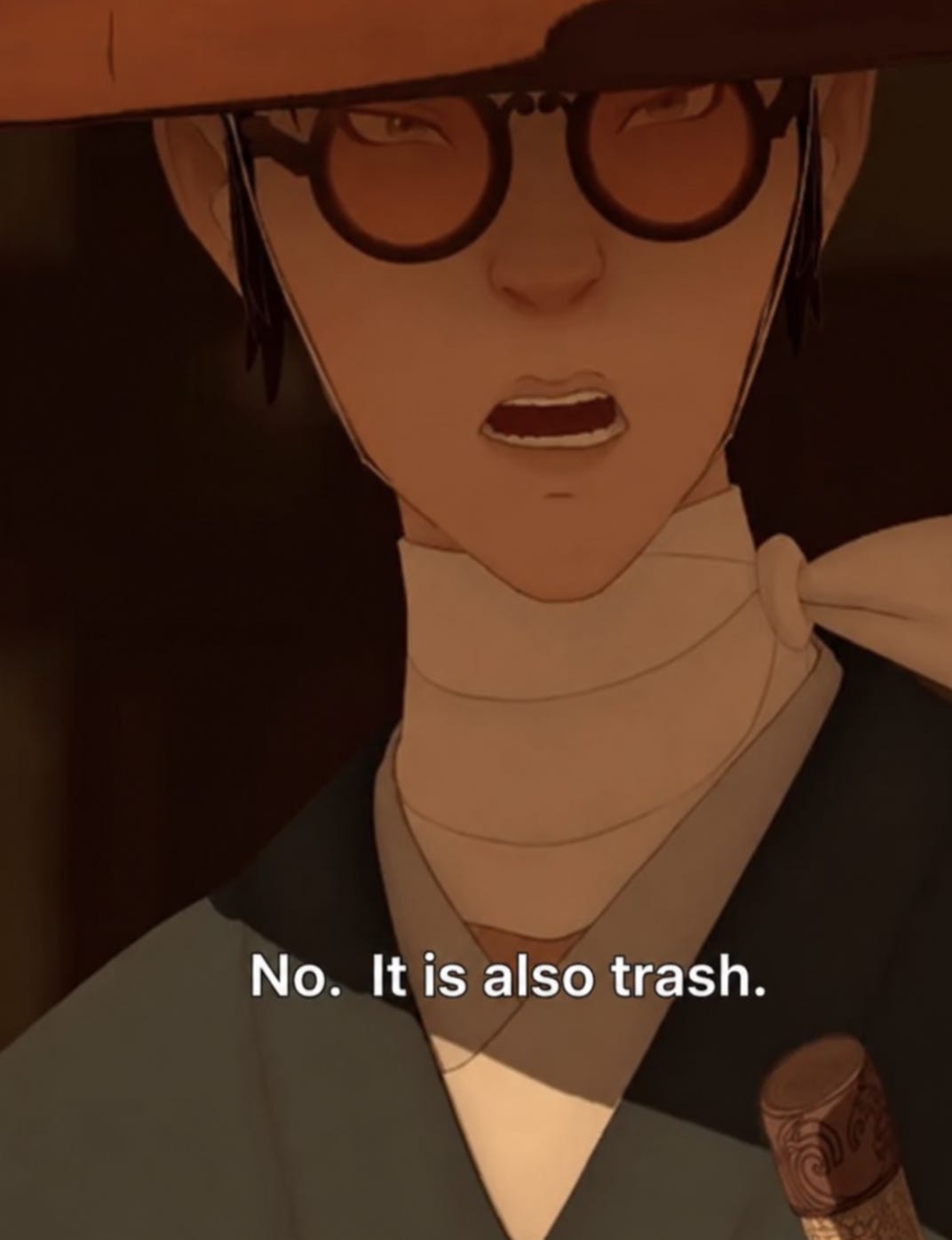
However, it will be trash at a fine, nigh-mystical register that I cannot perceive with my currently-limited perception.
Every dancer is a trash-fractal: when you correct a part of your dance that is trash then this correction will leave behind a small number of trash-particles, which your instructor will then hassle you about.
Most improvement in partner dance is like this. And it’s pretty slow going, in large part because…
Motor correction is hard without visual metaphors
I am definitely not the first person to notice this, and I won’t be the last. Freeing The Natural Voice— a voice training guide for actors— starts out its visualization exercises with this warning:
The first exercise will be useless if you read quickly though the instructions and realize that the resultant movements are to stretch and drop the spine down. It is a familiar exercise, and can be done quite mechanically, achieving some superficial release through the large external muscles of the body. But it is the process by which the stretching and dropping down are arrived at that constitutes the exercise. It is generally true in all the exercises that follow, that it is not what you are doing that is important, but how you are doing it.
Humans are not robots. We cannot simply will our hand to move up three inches to the right without calling into play a vast network of compensatory motor movements, each of which cause changes to ripple through the network of muscles in our body. Dancing is deeply counterintuitive to the body and thus in this context, almost all of those compensatory movements will be wrong.
This fact is the bane of all dance instruction. My salsa instructor wishes— I feel how she wishes!— that it were possible for me to merely allow my hand to drift three inches to the left. I wish this also. Alas, it cannot be done: the human motor apparatus cannot be defeated by brute force.
But this can be worked around; humans are better at imitation than pretty much anything else, and that is our key advantage.
My salsa instructor is really really dedicated to minute form corrections; she knows, at every step, precisely how far I’m off from true and exactly what movements of my body are necessary to correct it. For instance, one time I was working on sensual bachata body movement. She kept trying to adjust my arms and shoulders while stopping me from doing unhelpful compensatory muscle movements, and eventually I said (as I often do) “I’m gonna need a visual metaphor for this one.”
My instructor then (as she has many times before) stood there, thought a moment, and said: “Imagine that your ribs are a frying pan. You have put some grease in the frying pan, and your goal is to rotate your torso such that you are spreading that grease around to the entire pan.”
And this worked, as it generally does, and I think that’s because the “visual metaphor” approach works with the human motor system instead of against it. We have a vast and diverse array of movements we’re already memorized, or even that we kinda know how to do from first principles. I bet you could do a passable imitation of someone firing a longbow, right? You can see it in your mind’s eye: the person’s left hand holds the bow in front of him, the right hand draws it back. You could do this right now, regardless of whether you’ve actually fired a bow before, and this will get you into a position that would be very hard to replicate just by someone telling you “okay, now push your chest out more. More than that. No, keep your left hand where it is.”
The other day I corrected a postural issue with my salsa body movement by imagining that at every moment I had to be Iron Man firing his chest laser beam (forcing the opening of the chest.) Totally worked.
I think dance form corrections work best when done in this way. Alas,
some instructors are too damn talkative
I’ve known a few dance instructors that love to talk. You mess up a move, and they will expound for minutes on what the appropriate attitude is toward a rolling side pass or whatever and this will, I think, mostly not be time well-spent; dancing is only learned by dancing, not by listening to someone talk about dance. I suspect thirty seconds of speech is the upper limit to what can be usefully absorbed before trying to put it into practice.
If you’re like me, you’ll be uncomfortable cutting your instructor off in order to suggest running through the exercise again. I think probably a pretty good thing to do (if you want to) is frame it about your needs as a student. “I am a kinesthetic learner and cannot process lots of vocal instruction” is a neutral-sounding thing to say, and I think that allows you to mostly-bypass the tendency of some instructors to speak forever and ever.
Some people take an attitude of reverence toward instructors. They know more than you do; who are you to correct their pedagogy?
This is how I started my dance instruction, but at some point I realized that instructors are just people and they benefit from feedback about their pedagogy. Their understanding of how the dance works is unchallengeable (or I guess if it is challengeable then you need a new instructor) but when it comes to how to convey this knowledge you’re on relatively equal footing.
Have you read the inner game of tennis? Relevant thesis
Managing your private lessons is not straightforward at all! One trick I've found lately is the following: if I want to learn a move, I have saved at least 10 videos of it. I record my phone screen watching Instagram, edit the videos, and move them all to the same folder. Then, I have my laptop on during the lesson, and if my instructor mentions a detail that I wasn't aware of, we can quickly check the videos so I'll start to notice it. It's for sure much easier to get the idea when you see it vs when you're told what to do ;)