
Stonks Philosophy
Or, monetizing plan A

[not financial advice, also don’t ever listen to me about anything]
When does active investing make sense? The responsible answer in the professional-managerial class— of which I am a part— is “basically never.” What, you think you’re smarter than hedgefundies who are valuing stocks as their full-time job? The arrogance. The unmitigated hubris. Besides, the Efficient Market Hypothesis has in its relatively strong form “the market has priced in all future inputs to a stock’s profitability, and therefore if you think you have identified such an input by noodling for ten minutes then it is almost certain it’s priced in.” Instead, one invests in a broad-market index fund where you get maximal diversification and (in expectation) lower volatility compared to an arbitrary-selected basket of fewer names.
But I (and the rest of the rationalist community) had, over the last few years, several formative experiences where some people in the community were like “hey isn’t that a hundred-dollar bill laying on the ground” and others were like “NAH PROBS NOT, EMH BAYBEEEEE” and then the hundred dollar bill was snatched up by a pigeon and then everyone was like “oh yeah I guess that was a hundred dollar bill huh, guess that’ll never happen again.”
Repeat 4 or 5 times and you have a pattern and honestly around time #2 a few years back I said “fuck the EMH I’m gonna do some conviction-based thematic investing.”
Edge
What is edge?
Edge is “non-consensus but correct beliefs about the future.” Crucially, it is not necessarily secrets— the theoretical arguments for the AI buildout were being publicly discussed for years prior to Nvidia exploding.
Anyway, in order to establish that edge exists for you personally, you have to (1) figure out what consensus beliefs about the future are, and why they are held, and then (2) you need to know why they have substantial likelihood of being wrong. The Ideological Turing Test is, I think, pretty fundamental investing technology.
What is my edge? Well, I do know a lot about social anxiety as a disorder. Not super investable. More relevant is probably just that I am a part of the rationalist community and have the appetite to read long posts by e.g. Gwern and friends.
The rationalist community has a very good track record of being very early to things. The following is a list that influential members of the community were pushing as huge deals many years ahead of the mainstream:
AI and the scaling laws (he said so, so obviously.) See Gwern in 2020.
Bitcoin
GLP-1s.
Various altcoins during the post-covid cryptocurrency boom (oops, this one may have been a miss)
Effective Altruism (not really investable but still very important)
Of course, “AI is a huge deal” is now more-or-less consensus; what isn’t consensus is the ripple effect that’s likely to have throughout the economy since Gary Marcus types still perceive AI as being mostly an unproductive curiosity, of interest only to tech nerds, and Serious Economists view AI as “mildly positive in expectation, nothing special” (Acemoglu to my knowledge still has not revised his opinion that AI will produce an increase of ~0.5-1.5% GDP over the span of a decade.)
More-generally, rationalists like to extrapolate trend lines on graphs and are willing to do so even when this results in insane-sounding outcomes.
The Characteristics Of Fake Edge
Quoth HPMOR:
Mr. Malfoy is new to the business of having ideas, and so when he has one, he becomes proud of himself for having it. He has not yet had enough ideas to unflinchingly discard those that are beautiful in some aspects and impractical in others; he has not yet acquired confidence in his own ability to think of better ideas as he requires them. What we are seeing here is not Mr. Malfoy's best idea, I fear, but rather his only idea.
I’ve had good investment ideas; I’ve had bad investment ideas (oh, Ethereum); I’ve had investment ideas where they were quite close to being good ideas but then weren’t.
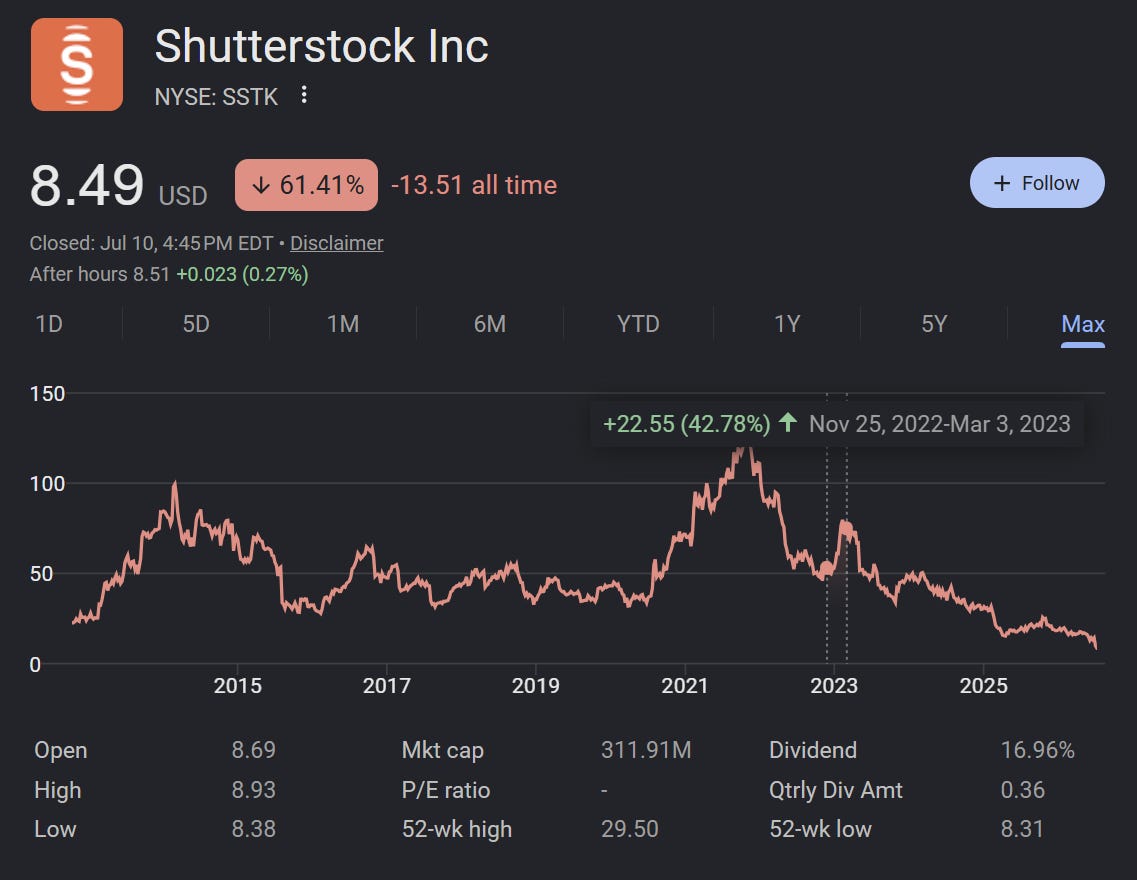
Guess who bought puts on Shutterstock on the strength of AI image models just before the stock spiked for unrelated reasons? Expiring, of course, when the puts were still out of the money. RIP.
As they say: “right on direction but wrong on timing” is, in finance, synonymous with wrong. Hubris!
More specifically I think the problem here was that I had a thesis— “this industry is structurally doomed”— but puts are mostly kinda mediocre as speculative instruments honestly? Especially if (as in my case above) the market for SSTK puts didn’t really exist for anything more than six months out, since if you’re holding onto puts that close to expiry you’re bleeding out the put’s value extremely quickly (“theta”). And shorts are even worse: you might get to profit on those eventually but you can’t eat “eventually,” especially not if you get margin-called and your account liquidated.
I think on some internal level a lot of why I ended up making the Shutterstock bet regardless was because it felt too clever to not make. Of course, I’m not so much a fool as to burn a huge chunk of my portfolio on that kind of bet, but I lost thousands of dollars regardless.
Lessons! Many lessons.
Where does the rat community still have non-consensus views?
The Strong AI Thesis: AI 2040 came out recently; its main purpose is as a policy whitepaper advocating for a global slowdown treaty. It also has an economics supplement, where it points out that conventional economists (Acemogle, Goldman Sachs) view AI as a fundamentally less impressive technology than the writers of AI 2040 did; and I accord the writers of AI 2040 significant credibility since they not only are the same people who did the quite prescient AI 2027 whitepaper but also were of the community that predicted the scaling hypothesis and its implications as far back as 2020.
The Strong AI Thesis also predicts the obsolescence of most white-collar labor that isn’t legally required to be done by a human in the next few years. In a brute structural way the most valuable asset, by far, that any white-collar worker owns is his years remaining as a viable worker. If Strong AI makes the value of this asset go to zero, AI investments may be required as a hedge.
IVF and polygenic screening technology. PGS has gotten really, really good. You can (at the cost of doing IVF + PGS) avoid having the worst of the genetic disorders today and once in-vitro gametogenesis takes off you’ll be able to cheaply sequence hundreds of embryos which can then be selected between for health and (more controversially) IQ. This will also allow for not doing the expensive and inconvenient IVF egg extraction process. IVG doesn’t yet work today, but Metaculus claims the first human baby from IVG is likely to come in ~2032. Which, uh, is somewhat after our AI thesis. Also the IVG companies are all private, so this is mostly non-investable anyway. Even so!
AI Will Likely Kill Us All. This is noninvestable; or rather, this might be investable in the sense that a large chunk of futures where a massive AI buildout happens humanity perishes as a result, implying that some unknown percentage of “AI explodes” should be totally devalued in terms of expected portfolio value.
What Remains Of The AI Thesis?
Or equivalently: “where does the rat community still hold non-consensus views as regards AI, and what are the investable differences between the market-projected predictions about the world and the rat-community predictions about the world?”
Interest rates due to AI-driven productivity. Most versions of the big-AI thesis involve productivity exploding, which drives the present value of money through the roof, which implies interest rates have to explode upward accordingly. Which implies somehow going short long-duration bonds, either via direct shorts or via long-dated OOTM puts on (probably) TLT. This is probably the most direct and within-community consensus trade, though it has problems in the possible worlds where he have a horrible non-AI disaster and the world goes tits-up since that is the world bonds are intended to hedge against. Which probably implies OOTM long-dated puts on TLT instead of shorts.
Broad-based economic productivity from AI translating into general stock price increases. The flip side of the interest rate trade is “long-dated OOTM calls on the S&P 500”; SPX has them up to five years out, which is nifty. The market is pricing such calls as lottery tickets if you crank them OOM enough; the argument that can be made is that they are exceptionally well-priced lottery tickets. The main problem: if interest rates skyrocket then the S&P 500 gets crushed. Ooops.
The current AI trade, but moreso. Semiconductor supply chains, power generation (especially portable power generation). This is already close to mainstream consensus, but if you take Ratworld seriously then likely then it’s almost certainly not consensus enough. At least over long enough time scales; note that AI 2040 buildout projects don’t really stop us from having an 2000-style economic meltdown such that current companies get hosed even as the underlying technology scales up as expected.
Megacorporations firing most of their workers and pocketing the difference. This mostly accrues to preexisting big tech players, ignoring business models. I’m fairly confident this occurs but less confident about whether this has a huge impact on prices such that it’s attractively investable; on the other hand, “invest in QQQ” has a fairly low burden-of-proof on it (also QQQ is strongly correlated with SPY which makes sense given that it is most of SPY), and that seems like the natural instrument for this sub-thesis.
Humanoid robotics. The better and cheaper AI gets, the more you want AIs to be able to do stuff in the real world. And the world is, mostly, built for things that are human-shaped.
….land? They’re not making more of it. Regrettably annoying to invest in directly unless you’re literally buying a house, and houses are illiquid and lumpy goods which also imply onerous maintenance requirements. Bawwww. That said, there are companies out there that mostly hold timberland and other low-value property.
What are the arguments that the rationalist community is just wrong about this stuff at a broad level?
I did, after all, point out the Ideological Turing Test bit above so I really should be able to answer this at a reasonable probability level.
Leg 1: AI Isn’t Good At Stuff
It hallucinates frequently; many of my techie friends hold the strong opinion that AI is not good at even coding stuff and is likely to never be.
Additionally, most jobs have as a crucial component that the person must be able to learn the job over time. AI right now is like a genius savant with amnesia: great for discrete tasks, terrible for any project that has to last longer than a context window.
I note only that feedback loops are getting better and better for AI stuff. “Make my website” followed by “break my website, then fix the breaks” works pretty well right now; God knows what it looks like a year from now. There is at least one good and useful website I know of (Glosso!) that was entirely vibecoded.
And if the “amnesia” part is solved somehow, that either leads directly to economic boom or to everyone dying. Or both!
Leg 2: AI Companies Are Super Leveraged Right Now And Thus Are Vulnerable To Economic Shocks
What if Trump starts another war? What if this is structurally similar to the dotcom bubble— where the tech was real but everyone was just too levered up and it all topples over?
The stock market can be resilient but is not automatically so. Even if AI is a real technology that upends the world over the next few years, that doesn’t help anyone if the major players are going bankrupt left and right, leaving the data centers and GPUs to be bought up at pennies on the dollar by whoever is left.
I think this critique is basically accurate and is why my portfolio isn’t stuffed to the gills with SOXL and TQQQ.
Leg 3: TSMC getting destroyed in a war sets the world economy back by a decade or something

Isn’t it kinda ghoulish to bet on stuff you think might contribute to ending the world
Probably! I basically stand by my Three-Futures Model here:

That is: you have the
Future Where Gary Marcus Is Right And AI Is A Bubble And Can’t Be Used To Do Stuff,
Singularity-Future (preceded by massive instability and likely economic boom)
Non-AI Disaster Future where AGI isn’t a thing because we couldn’t get there because the relevant labs have been destroyed for ~unrelated reasons. See also: war with China.
Pause AI Future (just added!) where people get freaked out enough to SHUT. DOWN. EVERYTHING. Nvidia hardest hit.
Some kind of hybrid future where AGI is created and is hugely relevant economically but money is still a thing.
I’m mostly discounting the first Gary Marcus Is Right future’s probability because [waves hands at current events]. The singularity future, meanwhile, is basically only investable in the short-term.
Investing in AI stuff, I think, kinda requires that hybrid future if it’s to be a good idea: where AGI is relevant, but we all live long enough to collect on our bets. But it’s still important to note that future #3 (non-AI disaster, including financial) is still a live option which is why I have a fair amount of portfolio ballast, mostly in short-dated treasuries (cash-adjacent!) and gold.
Really taking the ASI thing dead seriously might mostly imply an extremely boring portfolio that has an upsettingly large amount of gold and cash, living alongside megacap+AI-exposed equities as a hedge against AI-driven worker obsolescence, living alongside a small tranche of long-dated put options on long-duration treasuries? Wow, there’s a downer of a thesis to end on. I was hoping for a get-rich-slightly-quick scheme as opposed to a ride-out-doom-or-the-singularity-with-hedging-against-career-destruction scheme.
Even so.
Anyway! Bet-sizing is, of course, equally or more important than individual stock picks; for that I have hunches and modeling and prayer. Frankly I still go back and forth on whether I am being too aggressive or not aggressive enough in my allocations, which I understand is traditional.
Godspeed. Not financial advice.
I will continue to point out, whenever someone claims that rationalists were way ahead on Bitcoin, that knowing that Bitcoin might be adopted does not tell you very much about the per-unit value, which remains very arbitrary and speculative (in a way that literally makes it worse at its alleged core purpose of being a currency).
Before you start buying long-dated OOTM puts on TLT, I want to make sure you're aware that standard economics says that positive productivity shocks are deflationary, and will lead to lower interest rates. If there are theories out there that argue the opposite, I'd be interested in reading them.